Why Happy Time is Your Secret Weapon for Approachable Design
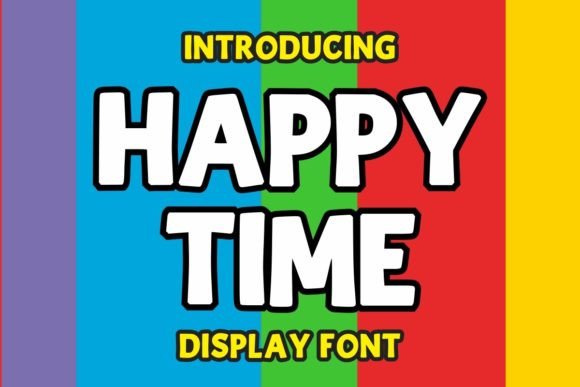
There’s a specific challenge that designers and brand owners face constantly: how do you make something look polished and professional while also making it feel genuinely welcoming? We often fall into the trap of using stiff, corporate fonts that look "safe" but lack soul. If you’ve been searching for a typeface that breaks that mold, offering a perfect blend of bold structure and playful energy, you might want to take a closer look at Happy Time. It is a comic, bold, and childish, easy-to-read display font that conveys impeccable friendliness. Whether you’re using it for crafts, digital design, presentations, or greeting cards, this font has the potential to become your favorite go-to font, no matter the occasion!
The Visual Impact of "Friendly" Typography
In the world of modern typography, "personality" is the currency of engagement. Happy Time isn't just a collection of letters; it’s a display font designed to evoke emotion immediately. Unlike a standard sans serif font that might fade into the background, or a complex script font that can be hard to read at small sizes, Happy Time occupies a unique sweet spot. It uses rounded terminals and bold weights to create a visual tone that is instantly approachable.
Why does this matter for your projects? Because visual communication is about psychology. When a potential customer or reader sees a typeface like Happy Time, their brain immediately processes "fun," "easy," and "unpretentious." This makes it an incredibly valuable design asset. It softens the barrier between your brand and your audience. If you are a small business owner trying to look authoritative but also relatable—think local bakeries, pet groomers, or children’s education apps—this typeface does the heavy lifting for you.
From Packaging to Digital Screens: Real-World Applications
The versatility of a premium font lies in how well it adapts to different mediums. Happy Time shines because of its readability, but its true value is unlocked when you apply it to specific contexts. It’s not just for logo design; it’s a workhorse for various creative needs.
- Packaging Design: If you are designing labels for a snack brand, a craft beer, or a toy, you need typography that pops on the shelf. Happy Time offers the necessary contrast to grab attention from a distance while maintaining a bold aesthetic that doesn't get lost in busy graphics.
- Social Media Graphics: In the fast-scrolling environment of Instagram or TikTok, you have milliseconds to make an impression. Using this font for headlines or call-to-actions on social media graphics creates an immediate "thumb-stopping" moment. It feels native to the casual nature of social platforms.
- Invitations and Greeting Cards: For crafters and hobbyists, finding a handwritten font or comic font that actually prints well can be a headache. Happy Time is designed for legibility, ensuring that the details of your party invites or birthday cards remain crisp, whether printed on textured cardstock or glossy photo paper.
- Merchandise and Apparel: When printing on T-shirts, tote bags, or mugs, simplicity is key. A bold, childish font translates beautifully to screen printing and embroidery, ensuring your merchandise looks high-quality and professional.
Strategic Font Pairing for Brand Identity
No font is an island. To build a robust brand identity, you need to understand how to pair your display typeface with your body copy. Because Happy Time has such a strong personality, it works best as the "voice" of your headlines, logos, and hero images.
If you pair it with a highly stylized script font, you risk creating visual chaos. Instead, let Happy Time do the shouting, and let a clean, geometric sans serif font do the whispering. For example, using Happy Time for a main headline like "Summer Sale" paired with a neutral font like Open Sans or Roboto for the product details creates a hierarchy that is easy for the eye to follow.
This approach ensures visual consistency. When your typography is consistent, your brand looks more established. It tells the customer that you pay attention to details. Whether you are building a website, laying out an editorial design, or creating marketing assets, this pairing strategy helps bridge the gap between playful branding and professional presentation.
Technical Considerations for Web and Print
While the aesthetic is crucial, the technical execution determines the success of your modern typography. As a display font, Happy Time is optimized for sizes where its details can be appreciated. Using it for long paragraphs of body text (like 10pt size) on a web design project might not be the best use of its capabilities; display fonts are meant to be seen.
However, for large-scale applications—such as posters, banners, and website headers—it excels. The "bold" characteristic ensures that even on lower-resolution screens or when printed on absorbent materials, the text remains legible. This is vital for readability considerations. You want a font that maintains its structural integrity whether it’s blown up to 72pt on a billboard or shrunk down to a button on a mobile app interface.
When you incorporate a creative font like this into your toolkit, you are adding a layer of flexibility to your design assets. It allows you to switch the tone of a project instantly from serious to lighthearted just by swapping the typeface, without needing to overhaul the entire layout.
Licensing and Commercial Use
For designers, entrepreneurs, and agencies, the legal side of typography is just as important as the visual side. One of the practical advantages of sourcing high-quality typefaces is the clarity of commercial licensing. Before deploying Happy Time in a large-scale commercial project or a client’s logo design, always verify the license.
A standard commercial license usually covers most standard applications, including digital products, websites, and physical merchandise. However, if you are creating a digital product for resale—such as a template that includes the font—you need to ensure the licensing allows for redistribution. Treating your fonts as proper business assets protects your work and your client's investment, ensuring that your brand recognition is built on solid legal ground.
Elevating Your Creative Workflow
Ultimately, the tools we choose dictate the speed and quality of our workflow. Having a go-to font that is reliable, expressive, and versatile saves time. Instead of scouring the internet for the perfect typeface every time a new brief comes in, you can rely on a creative font like Happy Time to deliver the right vibe.
It’s about finding the balance between being "childish" in the sense of being innocent and fun, and being "professional" in execution. Whether you are a content creator making thumbnails, a marketer designing email headers, or a hobbyist making scrapbooks, the right typography transforms the mundane into the memorable. Happy Time offers that distinct friendly edge that makes people smile before they even read the words.